
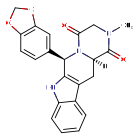
- Weight
- Average: 389.404
Monoisotopic: 389.137556111 - Chemical Formula
- C22H19N3O4
- Tadalafil
- Tadalafilo
About TADALAFIL
TADALAFIL belongs to the group of medicines called phosphodiesterase type 5 (PDE 5) inhibitors, primarily used to treat erectile dysfunction (impotence) and benign prostatic hyperplasia (BPH). Sometimes, TADALAFIL is also used to treat pulmonary arterial hypertension (high blood pressure in the lungs). Erectile dysfunction is the inability to keep a hard and erect penis suitable for sexual activity. Benign prostatic hyperplasia, also called as prostate enlargement, is the non-cancerous growth of the prostate gland.
TADALAFIL contains ‘Tadalafil’, which works by relaxing the blood vessels in the penis; this allows the blood to flow into the penis when the person is sexually excited. Thereby, it helps to treat erectile dysfunction. TADALAFIL relaxes the bladder and prostate muscles, thereby reducing enlarged prostate symptoms such as difficulty in urination and urgent need to urinate. TADALAFIL used to treat pulmonary hypertension (high blood pressure in the lungs) by relaxing the blood vessels in the chest. Thereby increasing the blood supply to the lungs and decreasing the workload of the heart.
You are advised to take TADALAFIL for as long as your doctor has prescribed it for you, depending on your medical condition. In some cases, you may experience certain common side-effects such as headache, back pain, muscle pain, pain in the legs and arms, nasal congestion, indigestion, and facial flushing. Most of these side-effects do not require medical attention and will resolve gradually over time. However, you are advised to talk to your doctor if you experience these side-effects persistently.
Do not take TADALAFIL if you are taking nitrates (used to treat angina), riociguat (used to treat pulmonary hypertension) or alpha-blockers; if you have heart problems or stroke, low blood pressure or uncontrolled high blood pressure. TADALAFIL is not intended for use in women. TADALAFIL may cause dizziness, so drive with caution. Avoid consuming alcohol as it might cause increased dizziness. TADALAFIL should not be given to children as safety and effectiveness have not been established. Keep your doctor informed about your health condition and the medicines you are taking to avoid unpleasant side-effects.
PHARMACOLOGY
Indication
Tadalafil
is indicated for the treatment of erectile dysfunction (ED) and either
alone or in combination with finasteride for the treatment of benign
prostatic hypertrophy (BPH).7,11 It is also indicated for the treatment
of pulmonary arterial hypertension (PAH) both alone and in combination
with macitentan or other endothelin-1 antagonists.
Pharmacodynamics
Tadalafil exerts a therapeutic effect in ED by increasing sexual stimulation-dependant smooth muscle relaxation in the penis, allowing the corpus cavernosum to fill with blood to produce an erection.2,3 Smooth muscle relaxation in the pulmonary vasculature helps to produce vasodilation in PAH which reduces blood pressure in the pulmonary arteries.3 In BPH, tadalafil may contribute to decreased smooth muscle cell proliferation which may reduce the size of the prostate and relieve the anatomical obstruction which produces urinary symptoms of BPH.4 The decreased affinity of tadalafil for PDE6 compared to other PDE5 inhibitors may explain the reduced incidence of visual side effects.
Mechanism of action
Tadalafil is a selective phosphodiesterase-5 (PDE5) inhibitor that produces several downstream effects with the most common therapeutic effect being smooth muscle relaxation. 7 Patients may experience ED due to a variety of causes including psychogenic, neurogenic, vasculogenic, iatrogenic, or endocrine. 6 These causes result in dysfunction of penile smooth muscle relaxation through either disrupted neuronal signaling or direct influence on smooth muscle cells. During sexual arousal, non-adrenergic non-cholinergic (NANC) neurons release nitric oxide (NO). Nitric oxide stimulates guanylate cyclase which converts guanosine triphosphate to cyclic guanosine monophosphate (cGMP).2,3 cGMP activates the cGMP-dependent kinase (PKG) in a signal cascade which activates K+ channels leading to inhibition of Ca2+ channels, inhibits platelet activation, and inhibits smooth muscle cell proliferation while inducing apoptosis. This signal cascade is attenuated by PDE5 which breaks the phosphodiester bond of cGMP, converting it to GMP. Inhibition of PDE5 by tadalafil increases signaling via the PKG cascade which supports penile smooth muscle relaxation during sexual arousal by decreasing Ca2+ entry into smooth muscle cells. This smooth muscle relaxation allows blood to fill the corpus cavernosum thereby producing an erection.
In PAH, blood pressure in the pulmonary arteries is raised due to a variety of mechanisms stemming from endothelial dysfunction.3 Decreased production of NO and prostacyclin reduce vasodilatory signaling while overproduction of endothelin-1 and thromboxane increase vasoconstriction. Inflammation, thromboses, and hypoxia later contribute to vascular remodeling which further reduces luminal size. The resultant increase in blood pressure reduces the capacity for gas exchange and increases afterload at the right ventricle, producing symptoms of dyspnea, fatigue, and dizziness as well as leading to right-sided heart failure. Tadalafil exerts its therapeutic effect in PAH through boosting NO-cGMP signaling to contribute to smooth muscle relaxation as with ED.
Lastly, tadalafil is used to treat BPH.7 BPH produces urinary dysfunction through hyperproliferation of the epithelial and smooth muscle layers of the prostate.4 The increased size of the prostate blocks urine flow through the urethra resulting in higher residual volumes due to incomplete emptying. Tadalafil does not appear to exert its benefit via smooth muscle relaxation of the prostate. It may instead exert its effect through a mix of increased oxygenation and decreased inflammation, which decreases tissue remodeling, and inhibition of cell proliferation through the cGMP cascade.
The decreased affinity for PDE6 compared to other PDE5 inhibitors may explain the decreased incidence of visual side effects as PDE6 is present in the eye and contributes to color vision.
Absorption
Tadalafil has a tmax of 0.5-6h with a median of 2h in healthy adults. The tmax in adults with PAH is reported as 2-8h with a median of 4h. There does not appear to be a significant effect on absorption when tadalafil is taken with food.
Tadalafil has a mean apparent volume of distribution of 63L in healthy adults.The mean apparent volume of distribution is reported as 77L in adults with PAH.
Tadalafil is 94% bound to plasma proteins.
Tadalafil is primarily eliminated via hepatic metabolism.These metabolites are mainly excreted in the feces (61%) and to a lesser extent in the urine (36%)
The mean half-life of elimination of tadalafil is 15-17.5h in healthy adults. The mean half-life of elimination in adults with PAH is reported as 35h.
The mean apparent oral clearance of tadalafil is 2.5-3.4L/h in healthy adults. The mean apparent oral clearance in adults with PAH is reported as 3.5L/h
Uses of TADALAFIL
Erectile dysfunction (impotence), benign prostatic hyperplasia (BPH), Pulmonary arterial hypertension (PAH)
Medicinal Benefits
TADALAFIL belongs to the group of medicines called phosphodiesterase type 5 (PDE 5) inhibitors. TADALAFIL is used to treat erectile dysfunction (impotence) and benign prostatic hyperplasia (BPH). Sometimes, TADALAFIL is also used to treat pulmonary arterial hypertension (high blood pressure in the lungs). TADALAFIL works by relaxing the blood vessels in the penis; this allows the blood to flow into the penis when the person is sexually excited. Thereby, it helps to treat erectile dysfunction. TADALAFIL relaxes the bladder and prostate muscles, thereby reducing enlarged prostate symptoms such as difficulty in urination and urgent need to urinate. TADALAFIL used to treat pulmonary hypertension (high blood pressure in the lungs) by relaxing the blood vessels in the chest. Thereby, increasing the blood supply to the lungs and decreasing the workload of the heart.
Directions for Use
Storage
Side Effects of TADALAFIL
- Headache
- Back pain
- Muscle pain
- Pain in legs and arms
- Nasal congestion
- Indigestion
- Facial flushing
In-Depth Precautions and Warning
Drug Warnings
Do not take TADALAFIL if you are allergic to any of its contents; if you are taking nitrates (used to treat angina), riociguat (used to treat pulmonary hypertension) or alpha-blockers; if you have heart problems or stroke, low blood pressure or uncontrolled high blood pressure, if you ever had a loss of vision. Inform your doctor if you have sickle cell anaemia (abnormal red blood cells), multiple myeloma (cancer of bone marrow), leukaemia (blood cell cancer), deformation in the penis, severe kidney or liver problems. Consult your doctor immediately if you experience loss of vision or hearing while taking TADALAFIL. TADALAFIL may cause dizziness, so drive with caution. Avoid consuming alcohol as it might cause increased dizziness. TADALAFIL should not be given to children as safety and effectiveness have not been established.
Drug Interactions
Drug-Drug Interactions: TADALAFIL may interact with anti-hypertensive (amlodipine, lisinopril, losartan, metoprolol, riociguat), alpha-blockers (tamsulosin), anti-anginal (nitroglycerin), anti-fungal (ketoconazole, itraconazole), antibiotics (erythromycin, clarithromycin), anti-TB (rifampicin), anticonvulsants (phenobarbital, phenytoin, carbamazepine), anti-HIV (ritonavir).
Drug-Food Interactions: No interactions found/established
Drug-Disease Interactions: Inform your doctor if you have cardiovascular/heart disease, renal dysfunction (kidney impairment), pulmonary disease, alcoholism, liver disease, seizure disorder, hearing loss, retinitis pigmentosa (loss of vision) and priapism (prolonged erection of the penis).
Safety Advice

Alcohol
CONSULT YOUR DOCTORYou are advised not to consume alcohol while taking TADALAFIL as it may cause increased dizziness.

Pregnancy
CONSULT YOUR DOCTORTADALAFIL is not recommended for use in pregnancy.

Breast Feeding
CONSULT YOUR DOCTORTADALAFIL is not recommended for use during breastfeeding.

Driving
TADALAFIL may cause dizziness. Therefore you are advised to drive and operate machinery only if you are alert.

Liver
Dose adjustment may be needed. Please consult your doctor before taking TADALAFIL if you have liver impairment/liver disease or any concerns regarding this.

Kidney
Dose adjustment may be needed. Please consult your doctor before taking TADALAFIL if you have kidney impairment/kidney disease or any concerns regarding this.
Habit Forming
Diet & Lifestyle Advise
Erectile dysfunction:
- Maintaining a healthy weight, eating a balanced diet, and regular exercising may help you manage erectile dysfunction.
- Avoid alcohol consumption as it may temporarily impair your ability to get an erection.
- Avoid the usage of tobacco.
- Share intimate time with your partner.
- Stay sexually active to prevent further problems with erectile dysfunction.
Benign prostatic hyperplasia (BPH):
- Avoid foods like sugars, carbonated beverages, tea, citrus fruits, tomatoes, spicy foods, chocolate and tea.
- Limit fluid intake as excess fluid intake could cause an urge to urinate frequently.
- Avoid drinking excess alcohol or caffeinated drinks as they can worsen the symptoms.
- Maintain a healthy weight, and exercise regularly.
- Quit smoking.
- Take 6-8glasses or liquids every day.
- Avoid processed foods. Instead, choose whole, unprocessed foods.
- Include fruits, vegetables, and fibre-rich food in your diet.
Special Advise
- Take TADALAFIL 30 minutes to 4 hours before sexual intercourse. However, it is best to take it an hour before sexual activity.
- Do not take TADALAFIL more than once a day. Take TADALAFIL as prescribed by the doctor.
- Talk to your doctor if the erection persists for greater than four hours.
Patients Concern
Disease/Condition Glossary
Erectile dysfunction: It is the inability to keep a hard and erect penis suitable for sexual intercourse. It could be a sign of physical or psychological conditions such as fear of sexual failure, anxiety, depression, low self-esteem, or stress. Certain health-related factors such as smoking, drinking, being overweight, being physically inactive, and high blood pressure also contribute to erectile dysfunction. Symptoms of erectile dysfunction include difficulty in getting an erection, difficulty in maintaining the erection during intercourse and decreased sexual desire.
Benign prostatic hyperplasia (BPH): Benign prostatic hyperplasia, also called prostate enlargement, is the non-cancerous growth of the prostate gland due to the multiplication of cells. This leads to swelling and squeezing of the urethra and limits the urine flow. It is an age-associated prostate gland enlargement which can cause problems with urination. BPH symptoms include loss of bladder control, frequent urination, inability to urinate, incomplete bladder emptying, weak urinary stream, dribbling at the end of the urinary stream, sudden urge to urinate, and painful urination.
Pulmonary arterial hypertension (PAH): High blood pressure affects the arteries in the lungs and heart, leading to pulmonary arterial hypertension. It occurs due to narrowed or blocked blood vessels which increases the workload on the heart. Symptoms include chest pain, dizziness, fatigue, and swelling in the legs and ankles.

No comments:
Post a Comment